SILK — Smooth Incision Lenticule Keratomileusis
Specs removal, reimagined.
Flapless, keyhole laser vision correction for short sight, with or without astigmatism — with a quick return to your routine.
(01) — What is SILK?
The next generation of laser vision correction
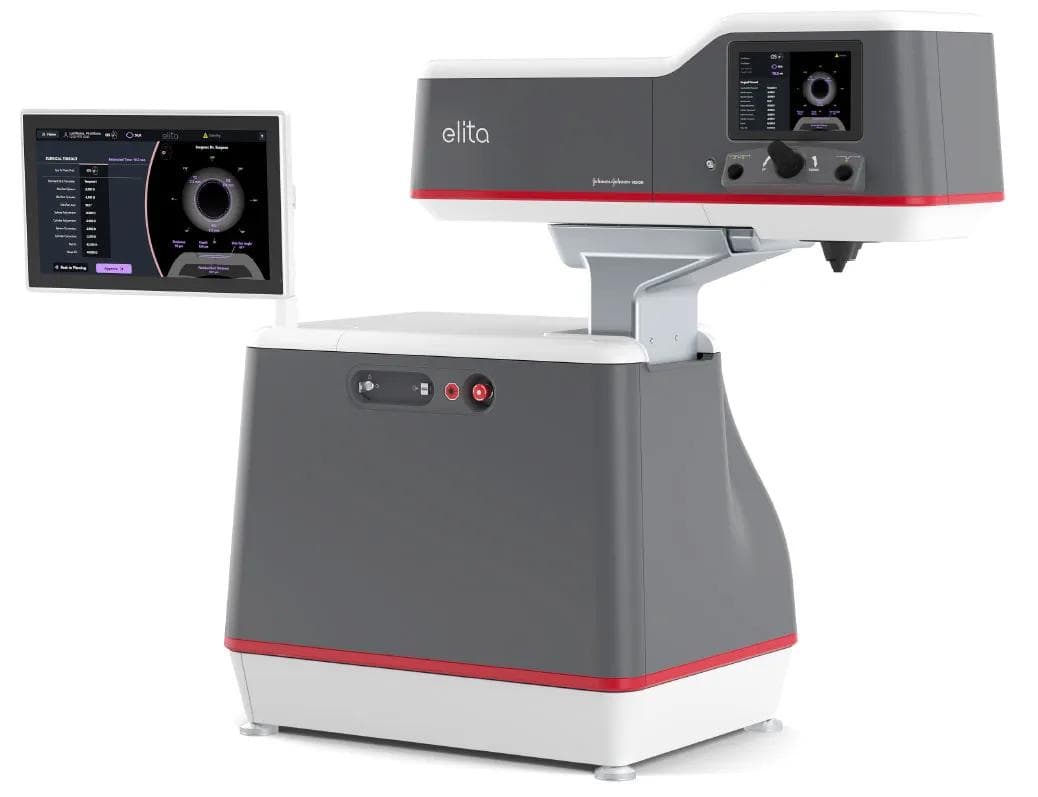
SILK (Smooth Incision Lenticule Keratomileusis) is the newest generation of laser vision correction for people who are short-sighted (myopia), with or without astigmatism. It is performed on the ELITA™ femtosecond laser from Johnson & Johnson — and is now available at Synergy Eye Care.
Instead of cutting a flap in the cornea, as in LASIK, the laser shapes a very thin, lens-shaped piece of tissue (a lenticule) inside the cornea. Your surgeon removes it through a tiny keyhole incision, and the cornea takes on its new shape — correcting your power without a flap.
Inside the ELITA™ laser
- ~1 µmLaser spot size
- 10 MHzPulse frequency
- 40–90 nJEnergy per pulse
- 100–200 fsPulse duration
(02) — How it works
Three steps, no flap
- 01
Create
After numbing eye drops, the ELITA™ laser uses ultra-fine, low-energy pulses to form a thin, disc-shaped lenticule inside your cornea, tailored to your prescription.
- 02
Remove
Your surgeon gently removes the lenticule through a tiny keyhole incision of about 2–3 mm. No corneal flap is created.
- 03
Reshape
With the lenticule removed, the cornea is reshaped so that light focuses correctly — and distant objects look clear.
(03) — Why SILK
Benefits of SILK
A gentler way to correct your vision — designed around comfort, speed and the long-term health of your cornea.
Flapless
No corneal flap means no flap-related complications — preferred in people engaged in sports and active lifestyles.
Keyhole incision
Just a 2–3 mm opening, helps in keeping most of the cornea's natural strength intact.
Gentle, low-energy laser
ELITA™ works with very low energy per pulse and ultra-fine spots for a smooth treatment surface.
Quick visual recovery
Most people see clearly within a day or so and are back to routine activities within a couple of days.
Designed to lower dry-eye risk
A smaller incision disturbs fewer corneal nerves than a LASIK flap — a common cause of dryness after surgery.
Freedom from glasses
Reduce or end your dependency on glasses and contact lenses for distance vision.
(04) — Clinical results
Proven in a clinical study in India
96%
eyes saw 20/20 or better at 3 and 6 months
85%
eyes saw 20/20 or better just one week after surgery
0
eyes lost lines of best-corrected vision at 6 months
170
eyes treated in the clinical study in India
Results from a prospective, multicentre study of the SILK procedure on the ELITA™ laser (85 patients, 170 eyes, 6-month follow-up), published in Clinical Ophthalmology, 2023. Individual results vary.
(05) — Compare
SILK vs LASIK
Both are excellent options at Synergy. Here is how they differ.
| Feature | SILK | LASIK |
|---|---|---|
| Corneal flap | No flap | Flap is created |
| Incision | Tiny 2–3 mm keyhole | Larger cut around the flap edge |
| How power is corrected | Lenticule removed from inside the cornea | Cornea reshaped under the flap |
| Dry eyes after surgery | Designed to lower the risk | Temporary dryness is common |
| Contact sports later | No flap to dislodge | Flap needs protection from injury |
| Powers treated | Myopia, with or without astigmatism | Myopia, hyperopia and astigmatism |
Not suitable for SILK? We also offer LASIK, ICL and refractive cataract surgery.
(06) — Is SILK right for me?
Who can have SILK
You may be a good fit if
- You are 18 years or older
- Short-sighted (minus power) up to −12.00 D
- Astigmatism up to −6.00 D
- Your glasses power has been stable for at least a year
- Your corneas are healthy and thick enough on testing
- You want to be less dependent on glasses or contact lenses
SILK may not suit you if
- Long-sightedness (plus power) — LASIK or other options may suit you
- Pregnancy or breastfeeding
- Keratoconus or a thin / irregular cornea
- Severe dry eyes or active eye infection
- Uncontrolled diabetes or autoimmune disease
The final decision is made by your surgeon after a detailed workup of your eyes.
(07) — What to expect
Your SILK journey
- 01 · Before
Detailed SILK evaluation
- Corneal mapping, thickness measurement and dry-eye check
- Accurate glasses power and full eye examination
- Stop soft contact lenses for a few days before testing, as advised
- Your surgeon confirms whether SILK, LASIK, ICL or another option suits you best
- 02 · Surgery day
Quick and comfortable
- Numbing eye drops — no injections
- The laser part takes only a few minutes per eye
- Both eyes are usually treated on the same day
- You go home the same day — bring someone along
- 03 · After
Fast return to routine
- Use your eye drops exactly as prescribed
- Follow-up check the next day
- Don't rub your eyes; avoid swimming and eye make-up for about a week
- Most people resume work and screens within a couple of days
(08) — Your specialists
Refractive surgeons

Vitreoretina, Cataract and Refractive
Dr. Vinay Garodia
Founder Director
MBBS (AIIMS), MD (AIIMS, Gold Medalist), DNB, MNAMS, FRCS (Eng)

Cataract and Refractive
Dr. Vivek Pal
Former Director, Navjyoti Eye Centre
MBBS, DO, FICO (Japan)
(09) — FAQs
Common questions
Is SILK painful?
No. Numbing drops are used, so you feel only mild pressure for a short time. Some people notice watering or grittiness for a few hours afterwards.
Is SILK safe?
In the clinical study of 170 eyes in India, there were no serious adverse events and no eye lost lines of best-corrected vision at 6 months. Like any surgery it has risks, which your surgeon will explain after your evaluation.
How soon can I go back to work?
Most people return to desk work and screens within a couple of days. Your doctor will guide you on sports, swimming and travel.
SILK or LASIK — which is better for me?
Both give excellent results. SILK is flapless with a tiny incision, while LASIK can treat a wider range of powers, including long sight. After your tests, our surgeon will recommend the option that best fits your eyes and lifestyle.
Will I ever need glasses again?
SILK corrects your current distance power. After about 40, everyone naturally develops presbyopia and may need reading glasses — this is age-related and not a sign that SILK has worn off.
How much does SILK cost?
The cost depends on your evaluation and treatment plan. Call or WhatsApp our team for current pricing and to book your SILK evaluation.
Ready to see life without glasses?
Book a detailed SILK evaluation at our South Extension or CR Park centre and find out if SILK is right for you.
SILK™ and ELITA™ are trademarks of Johnson & Johnson. Product image courtesy of the manufacturer. This page is for general information and is not a substitute for a medical consultation.
Sources: Safety and effectiveness of SILK with the ELITA femtosecond laser — Clinical Ophthalmology, 2023 · Understanding SILK — Johnson & Johnson Vision